This edition arrives later than expected. In May, we were caught by surprise when the Mentira Tem Preço community, named after our information integrity program, was unexpectedly suspended from Instagram, owned by Meta. No warning. No notification. One moment, our anti-disinformation video was going viral, nearing 100,000 organic views and bringing in thousands of new followers. The next moment, we were taken offline.
We soon realised we were not alone. Dozens of accounts are, in one way or another, being silenced—from journalists to civil society groups working on climate and LGBTQIA+ issues.
I began bringing these groups together to better understand the situation, exchange lessons learned, and collectively learn alongside fellow organizations. Here, I would like to reiterate the thanks I have already shared privately with Sleeping Giants Brasil and Ctrl+Z.
If you know someone going through this kind of forced digital blackout (or trying to find solutions) please reply to this message with an “Oii!”. We need more of an “ant colony instinct”: lots of people reacting together when a threat appears.
Our account was finally restored on 1 June. We can now share it with you again, and we’ve already published what we learned from the experience. Throughout the entire process of trying to reactivate our community, we never received a human response from the platform. Not once.
Summary:
This month you’ll be getting a double dose of Oii — stay tuned;
MTP will soon be expanding to another platform. We can’t be silenced by losing a single channel!
How can a single post trigger a global disinformation crisis?
May was the month of Donald Trump in Brazil. And not only because social media fell in love with the “Trump Buffalo”, a buffalo in Bangladesh that escaped slaughter thanks to its uncanny resemblance to the American president’s hairstyle. The story quickly became one of the most-read articles across Brazilian news outlets.
Do you see the resemblance? I’m not so sure.... (image from the internet)
Trump was the flavor of the month in Brazil because he hosted the two leading contenders in the October presidential election in the White House. On May 7, he met with Lula, the current president and frontrunner in the polls. On May 26, he met with Flávio Bolsonaro, the son of former president Jair Bolsonaro, who is imprisoned for attempting a coup d’état, and who is second in the polls.
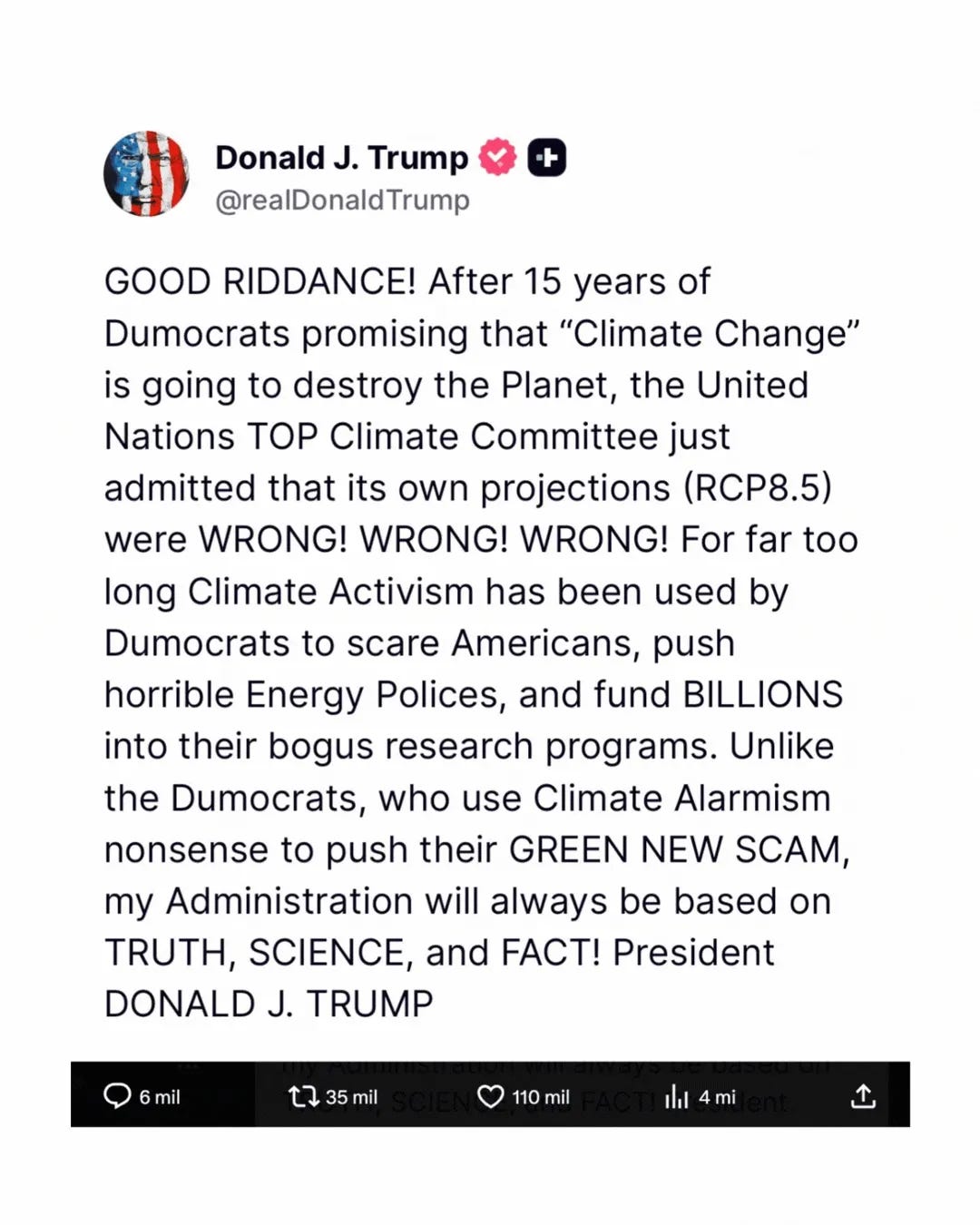
Trump was also a star on Brazilian social media, away from the spotlight, triggering our monitoring alerts several times. This was all because of a post he made on May 16, between his meetings with our presidential candidates. The post amassed 4 million views and was shared by the official White House Twitter account.
Trump’s climate disinformation, shared by the White House’s official Twitter account (@WhiteHouse), had received more than 4 million views by the time this newsletter was published.
Can a single post change everything?
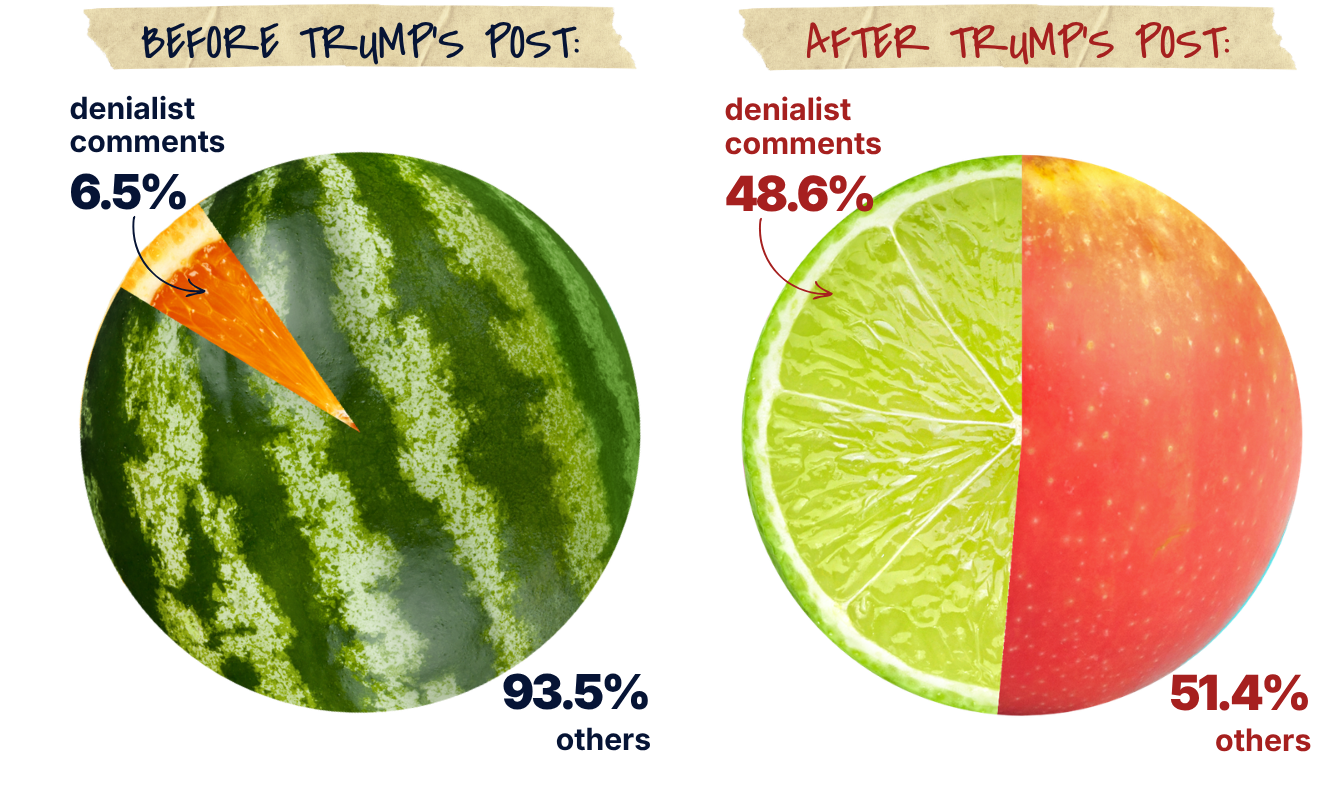
Friends of the Earth, a partner of the Observatory for Information Integrity, analysed the effects of climate denialism promoted by government figures. After a single post from Donald Trump, the share of climate-denialist comments surged from 6.5% to 48.6%—an increase of almost 650%. In other words, online discussions ended up containing 7.5 times more climate disinformation than before.
In the United States, according to CarbonBrief, Trump’s post was reported as fact by news outlets such as Fox News and the New York Post. Those who study climate disinformation see a direct impact on public perception when these avalanches of disinformation occur.
To any climate scientist, the U.S. president’s message is like a game of “Spot the Difference” between information and disinformation. We’re not climate scientists, but we did some digging to explain everything to you:
The UN’s “TOP climate committee”, the IPCC, is not responsible for the climate model cited, RCP8.5, and has never said that the model is wrong—let alone “WRONG! WRONG! WRONG!”;
RCP8.5 is one of four benchmark climate scenarios, known as Representative Concentration Pathways (RCPs), developed in the early 2010s to help researchers explore a range of possible futures. It was never treated by scientists as a forecast of what would happen by 2100, but rather as an extreme scenario designed to assess potential risks;
Beginning in 2017, scientists started using a new generation of scenarios called SSPs (”Shared Socioeconomic Pathways”). Rather than looking only at greenhouse gas emissions, these models also consider factors such as population growth, economic development, inequality, education, technology, and public policy when projecting different possible futures;
Scientists continue to affirm that global warming is real, is primarily caused by human activity, and poses serious risks to societies and ecosystems. The fact that one extreme scenario has become less likely does not mean the climate crisis is over or that scientific projections were “all wrong”. In fact, as technology advances, forecasts are becoming more accurate, which makes taking measures to prevent the worst outcomes even more urgent.
The bad news is that none of this matters on the internet, especially to those who benefit from the visibility and engagement generated by denying climate change.
In Brazil, we saw social media platforms (especially former Twitter) flooded with Trump’s disinformation. Below are a few examples.
One of the posts received more than 10,000 views.
Energy Vampires
A new report from Greenpeace Australia warns that the rapid expansion of artificial intelligence data centres could increase dependence on fossil fuels, raise greenhouse gas emissions, and place additional strain on already overloaded electricity grids.
We’re already seeing similar concerns emerge in Brazil. More on that soon.
And the impacts aren’t only environmental...
The UN, in partnership with the Conscious Advertising Network (CAN), has published a new report with a warning: the rapid adoption of artificial intelligence in advertising could deepen the global information integrity crisis. The report highlights risks such as the amplification of disinformation, a lack of transparency in automated media-buying systems, and growing pressure on independent journalism.
Mapping the Risks
A study on oil spill risks published in the journal Conservation Letters by researchers from ICMBio, the University of Porto, and the Federal University of Bahia found that the area between the states of Ceará and Rio Grande do Norte faces the highest risk of environmental impacts in Brazil’s Equatorial Margin. Based on simulations of oil spill trajectories, the study concluded that potential spills could damage seagrass meadows, mangroves, coral reefs, and rhodolith beds—structures formed by calcareous algae.
Long-time readers already know what the main company seeking to operate in the region told the local community, right? Spoiler: absolutely nothing about these risks.
Disinformation is organized, and so is the response
CONTENT LICENSE The content of this newsletter may be freely republished, in whole or in part, provided that the source is credited with the name of the publication. Reproduction may not be used for commercial purposes or to distort the original content.