
COP disinformation hits record high
The lies spreading across social media threaten the “COP of truth” announced by President Lula at the UN


In previous editions…
#4 How does a lie become law?
#5 COP30: The New Climate Denial Is Economic

Just hours after President Luiz Inácio Lula da Silva declared to the world that “this is the COP of truth,” we joined the High-Level Solutions Dialogue on Information Integrity on Climate Change, convened by the UN, Brazil, and UNESCO. The mission: to discuss solutions for climate information integrity — and how to confront the challenge with urgency, courage, and collaboration.
The supply chain of lies works like a global franchise with local branches. Tactics are transnational: lies, talking points, and formats travel across countries; disinformers feed off each other; platforms provide scale. We’ve seen direct imports of falsehoods such as “globalists” and “deep state,” along with anti-COP movements, as well as “locally accented” disinformation tailored to the Brazilian context. Global problems demand urgent global responses.
The most repeated points here:
The cost of disinformation — and how it is monetized
The concentration of power and money, including the advertising market
Threats against stakeholders, environmental defenders, journalists, scientists, and other professionals and leaders
Greenwashing
Litigation

With only 50 days remaining until COP30, the spread of climate disinformation has doubled. Keywords related to the global conference appeared 14,000 times alongside words like “disaster,” “joke,” “catastrophe,” and “failure”. This represents a 267% increase compared to July.
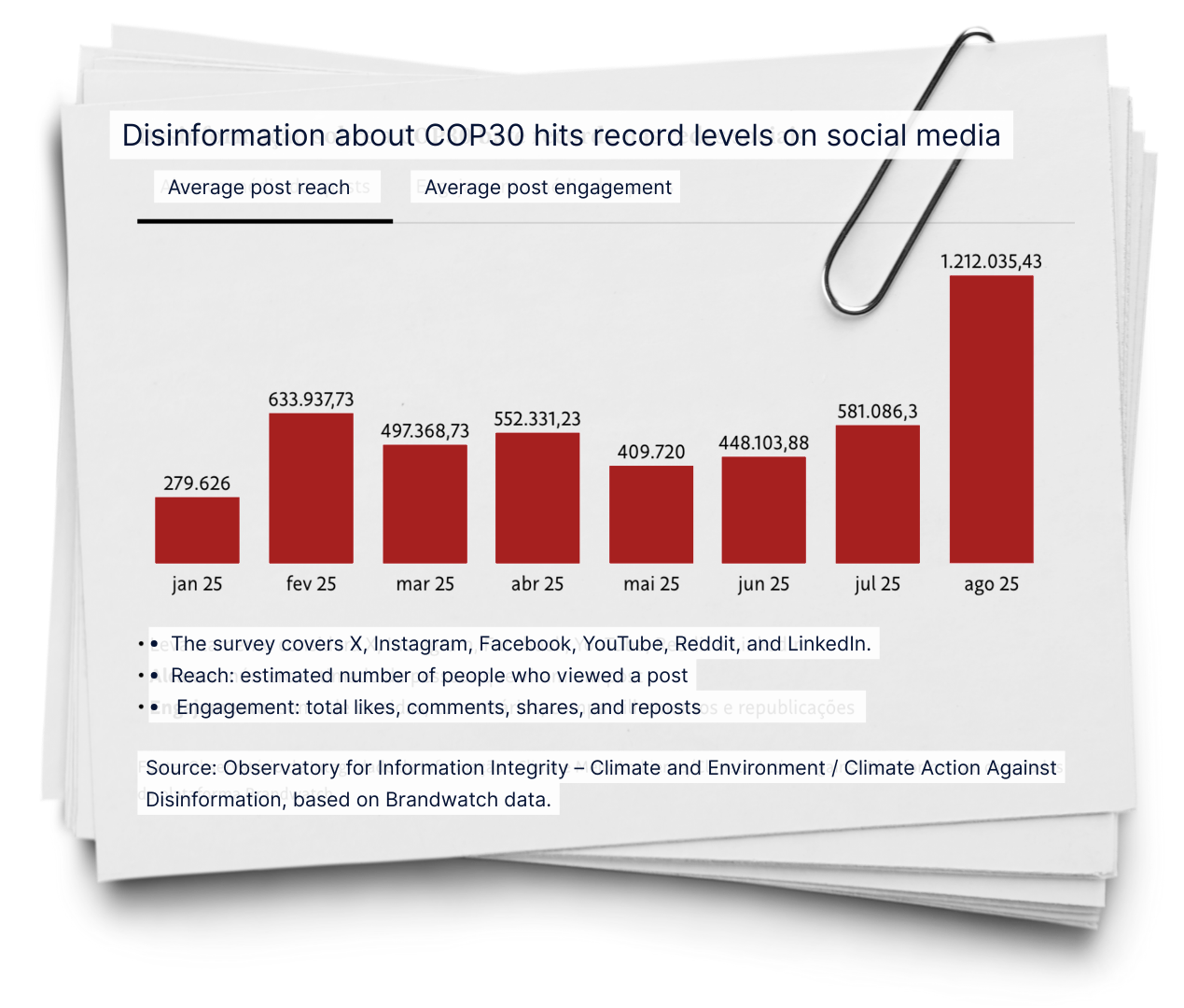
This data survey, carried out by the Observatory of Information Integrity in partnership with Climate Action Against Disinformation (CAAD), was published exclusively by reporter Gabriel Gama in the Folha de São Paulo.
Short videos, criticism, angry comments… all fueled by lies. Of the 100 posts about COP30 over the past month, 30 contained lies or disinformation tactics identified using the Climate Disinformation Reference Guide, produced by FALA Impact Studio and CAAD.
That’s why we always say that internet users (or consumers) aren’t responsible for this mess; it’s all the fault of the supply chain of lies.
To illustrate this, let’s play a game!
Can you (the internet user!) spot the difference between truth and lies in this story? The second most-viewed video in August, which reached 1.9 million people, shows an elegant woman—supposedly a business executive—walking through alleys and side streets—supposedly in Belém—to reach her destination—supposedly her accommodation for COP30, at the outrageous price of 300,000 reais per week. It’s shocking, right?

DISINFORMATION TECHNIQUE #1:
Taking a Real Video out of Context
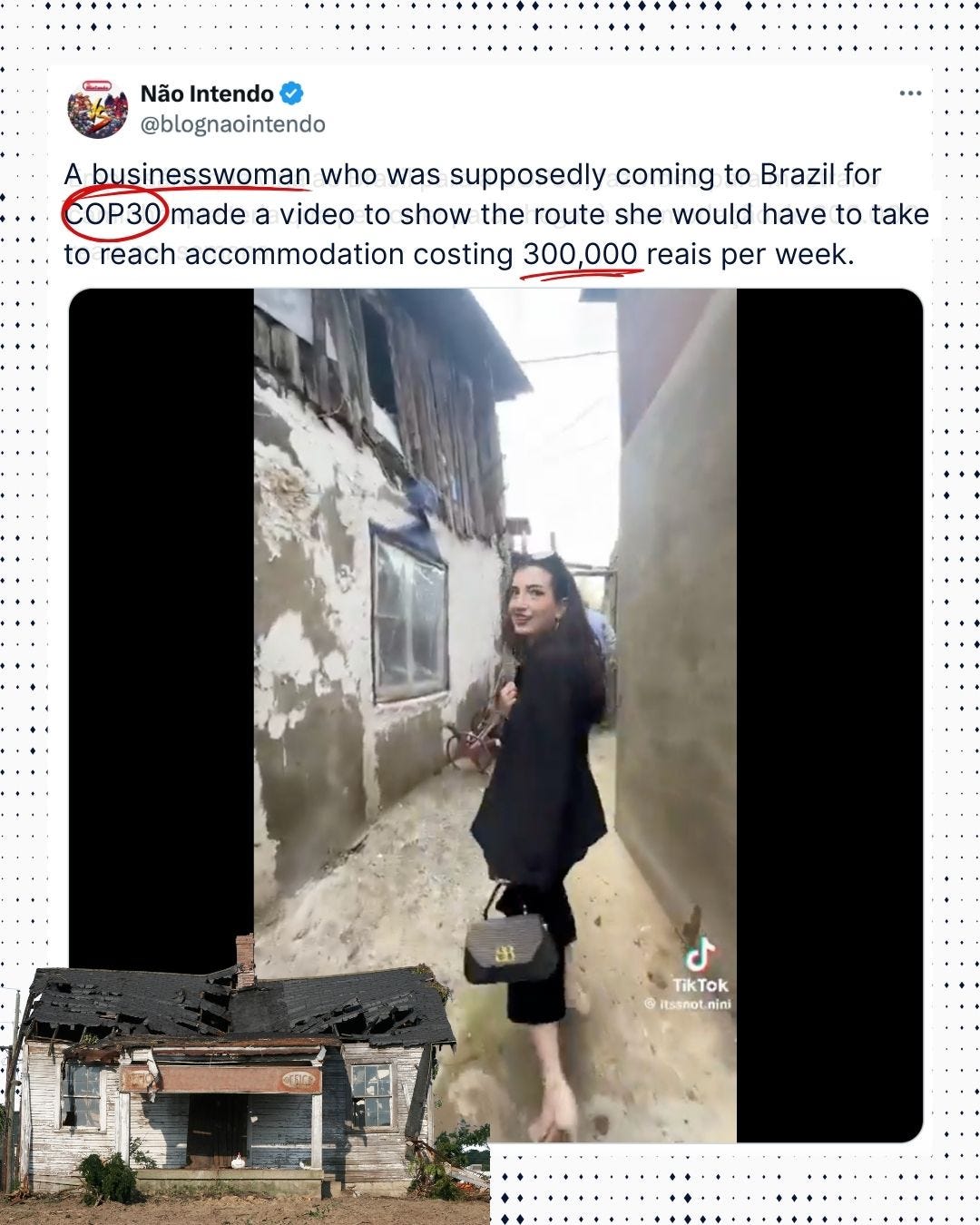
REACH: 1.9 million
ENGAGEMENT: 23,000
SOURCE: CAAD, with data from Brandwatch
Here’s the thing: the video itself is real, but the woman in it is not a businesswoman, she is not in Belém, and she likely won’t attend COP30. According to the Observatory for Information Integrity, confirmed by the Folha de São Paulo: “The landscape reveals that the original footage was filmed in Tbilisi, the capital of Georgia, and not in Belém. One segment of the video shows Narikala Fortress, a medieval structure dating back to the 4th century.”
DISINFORMATION TECHNIQUE #2:
The Time Machine
With a cell phone in her hand, a tourist shows the unsanitary surroundings of the Ver-o-Peso market in Belém, the city hosting COP30, and expresses outrage at the number of vultures in the area. The video is indeed from Belém and was made by a tourist…but it’s two years old!
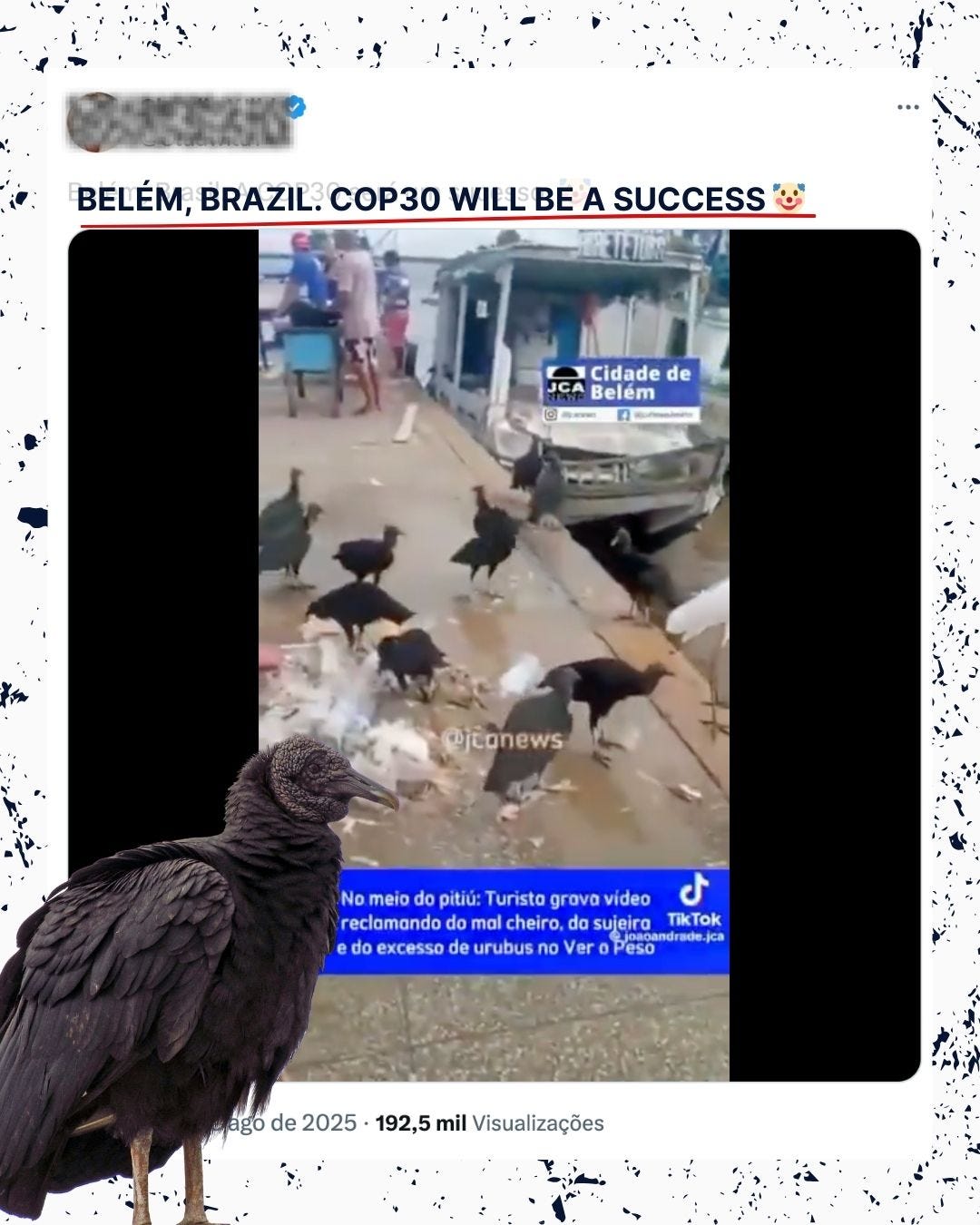
REACH: 2 million
ENGAGEMENT: 18,000
SOURCE: CAAD, with data from Brandwatch
“But who’s to say it’s not exactly the same now, Ms. Oii?” asks a fictional reader I imagined, conversing with the newsletter in a slightly formal tone.
Relax, my dear fictional reader. According to a July report by the Folha de São Paulo, the Ver-o-Peso market is “in the process of revitalization, including renovations to the 168 stalls in the main market, with new canvas coverings, lighting, paving, and a fire prevention system.” The renovations also cover “sanitation of the whole complex.”
DISINFORMATION TECHNIQUE #3:
Artificial Intelligence
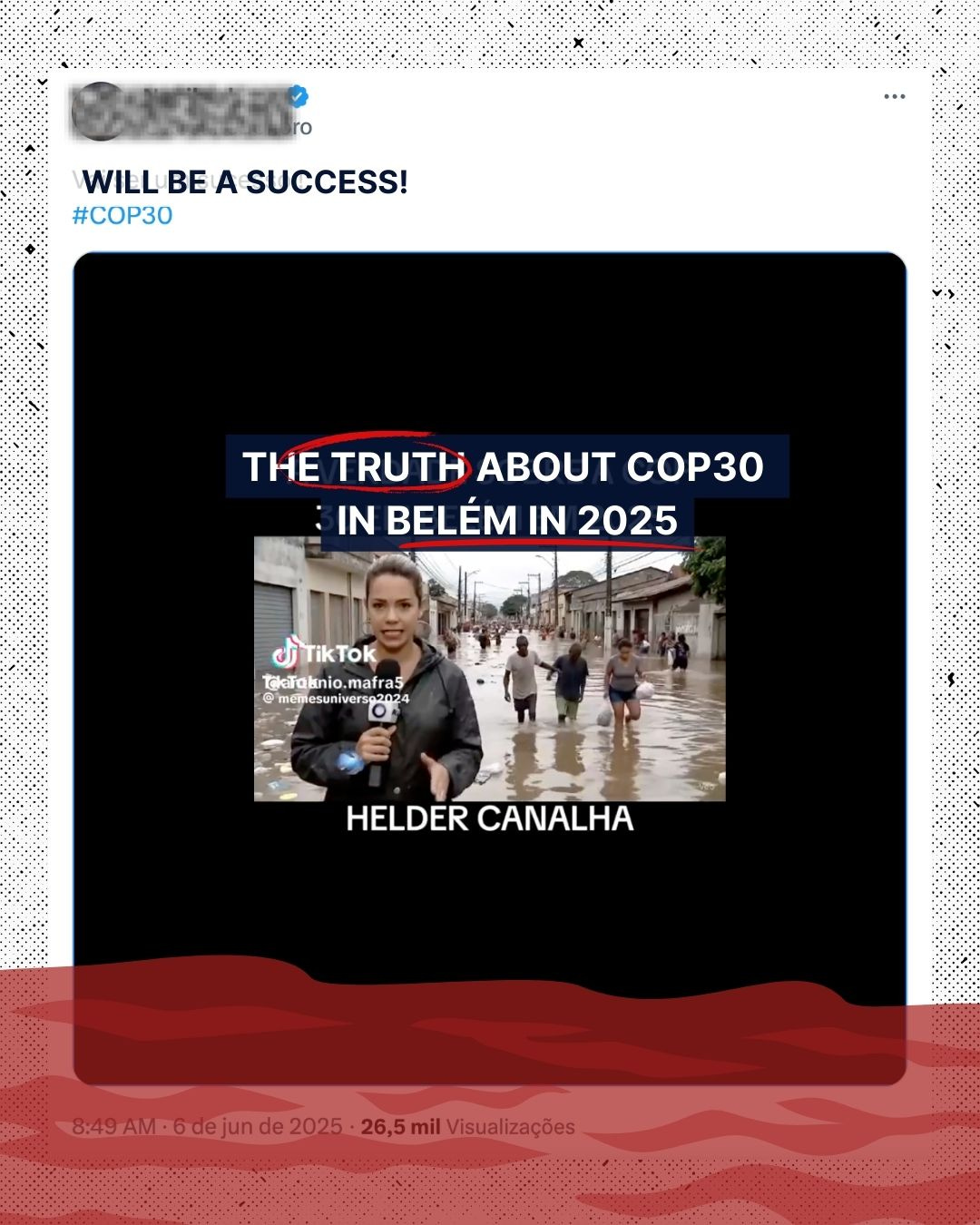
REACH: 460,000
ENGAGEMENT: 5,600
SOURCE: CAAD, using Brandwatch data
“This is the Belém of COP30 that they want to hide from the world,” says a reporter standing knee-deep in floodwaters in the capital of Pará. But…none of it is real! The reporter doesn’t exist, the people don’t exist, the flood doesn’t exist, and the city doesn’t exist. The only thing that does exist is the abundance of angry comments against the politician mentioned in the video and against the climate conference in Belém, on X (formerly Twitter) and TikTok.
It’s worth noting how the social media platforms responded to the Folha de São Paulo newspaper’s invitations to comment on this story: “Meta, which controls Instagram and Facebook, and YouTube just sent links to their general disinformation policy pages, which make no mention of climate issues. LinkedIn did not comment. X and Reddit did not respond.” Do they seem at all concerned?

Oii made the news…
Our monthly roundup of the lies being spread about COP30 — the same one you always read here — inspired a great story by journalist Gabriel Gama in Folha de S. Paulo. We might be biased, but it’s really good. Go check it out!
… and hit TV too!
The shocking numbers we uncovered also turned into an excellent piece on TV Cultura, by journalist Henrique de Jesus. Besides our own Thais, the report featured Letícia Capone, director of Instituto Democracia em Xeque, and Nina Santos, Deputy Secretary for Digital Policies at Brazil’s Federal Government Communications Secretariat. Don’t miss it!
